| by
Ann Gibney, Ph.D.,
Scattergold Devon Rex
This article appeared in the October 1993 issue of the CFA Almanac.
More and
more people are becoming pixilated. This pleasurable state is achieved when one
cohabits with a Devon Rex, the pixie of the cat species. CFA records indicate
that 592 Devon entries were made in
Championship classes in 1991-1992, compared to 173 in 1988-1989, an increase of
340%. In the same period, membership in the Devon Rex Breed Club went from 25
to 61. What is it about these delightful creatures that would cause such
phenomenal growth in popularity?
The breed
seems to have been created to fit perfectly into our modern style of life.
Imagine an animal with a little voice; that mostly speaks only when spoken 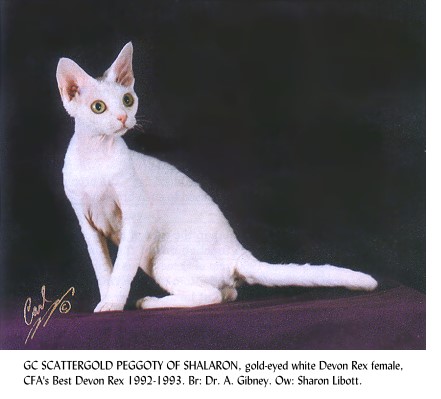 to;
that sheds almost unnoticeably; whose chief joy is to be around people and,
therefore, doesn't need large amounts of territory; and that is happy to doze
near the greatest heat source until its people return; and you will understand
why the Devon Rex makes an unexcelled pet for busy city dwellers. to;
that sheds almost unnoticeably; whose chief joy is to be around people and,
therefore, doesn't need large amounts of territory; and that is happy to doze
near the greatest heat source until its people return; and you will understand
why the Devon Rex makes an unexcelled pet for busy city dwellers.
People
really are the main focus of this breed. Visitors unfamiliar with Devons are
amazed at the greeting committee which converges on the entryway for every
arrival and surrounds the visitor to escort him to his seat--and of course to
share it. The Devon owner, on the other hand,
will readily recognize the following nightly scene: the owner settled on the
sofa, a neuter relaxed and purring in her arms in baby position, one paw on her
neck, while a female perches on the back of the sofa and runs her carefully
trimmed claws dreamily through the person's hair. Meanwhile, a kitten drags his
kill--an old electric blanket--off a chair and across the room to drop it at
his owner's feet.
The
people-fixation begins very early in life. Even three-week-old kittens will
toddle across the box and lift their faces in anticipation of a kindly touch
when they sense the familiar approach of the person in their lives.
Trouser-climbing is one of the earliest learned skills.
From the
time they can follow you around, Devons will try to be close, to
"help" with every task, from reading to bathing, and to converse with
you about it in a quiet but incredibly varied commentary. Their very favorite
activity is, of course, meal preparation, with clean-up of the dishes a close
second. But when activities are over, cuddle time is always welcome.
Because
Devons are so social, they are eager to please. And because they are
intelligent, they learn a number of English words--the command
"down!" is probably the first acquisition--and obey, at least
temporarily! A squirt bottle is a useful training adjunct. Of course, the odd
Devon does overcome his fear of this, like the one who
would wrap paws around the bottle in trying himself to make it squirt, and who
would have used it as his only source of drinking water if only he could have
found someone to squirt it on his every demand.
When
it comes to lounging, Devons are heat-seekers. Acting
as a heat-source is one of the most productive functions
to which a person may be put, in a Devon's view, but
in a pinch, even hugging a warm coffee pot will do.
The Devon Look
The Devon
look comes straight from the founder, Kirlee.
He was
endowed with large, low-set ears that stood away from his head like the handles
on a jug. His prominent cheekbones, strong muzzle on a rather short head, and
slender neck accented his ears to create an overall elfin appearance quite in
keeping with his winsome personality.
Overall,
the Devon head is a complex and subtle
combination of curves and planes. For example, the top skull is flat, but the
forehead curves back to it. From the front, the underlying shape is a wedge
bounded by straight lines, but projecting beyond the wedge are three sets of
curves: whisker pads, cheekbones, and earlobes.
Of course,
the loosely waved coat was the original feature that caused cat breeders to set
Devons apart. It is like no other rex coat, being caused by a unique mutation.
But as several mutations have been recorded, and as three rex breeds are now
recognized by CFA, it is to the head that we turn to see the true uniqueness of
the Devon Rex. In the truly typey Devon, the
look is visible from across the room.
As for
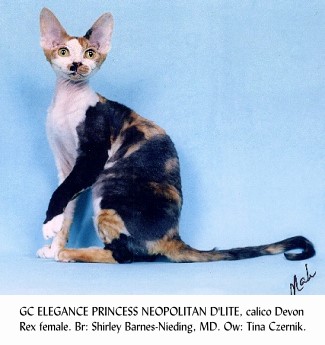
color, think of a rainbow. Devons are recognized in all colors and patterns
(except for non-tabby agouti and sable), the only breed with this distinction.
The Devon Breeding Program
In
general, Devons are easy keepers. Their appetites are, to say the least,
unfinicky. Daily grooming is straightforward consisting mostly of heavy
petting. This last task is hardly onerous to either petter or petted! Show
bathing is usually quick, with towel- and air-drying the norm.
There is
only occasionally a territorial problem in catteries, because Devons are as
social with each other as they are with people. Devons in groups are normally
found lounging in shoals and heaps. Even whole males can often live together.
Most
litters deliver easily. Induced labor and cesarean section are the exception
rather than the rule. Litter size is on average three to four. Devon queens are usually tolerant and loving. Queens in a non-cage situation will often get together to
organize a creche for their litters, whereafter mothering by committee becomes
the approach to kitten rearing. Even many adult males will join in, happily
letting older kittens suckle on them after the queens have weaned them.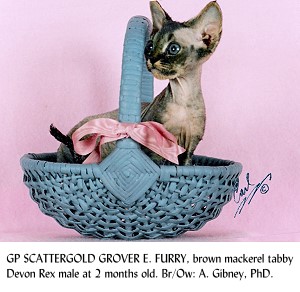
The breed
does present one challenge in breeding: one arising from the presence in cats
of two blood types, A being genetically dominant to B. In most breeds, A's far
outnumber B's. Devon Rex and some other breeds show a significant percentage of
B's: Persian, Abyssinian, Somali, Scottish Fold, Birman, British Shorthair, and
Cornish Rex. These last two and Devon Rex show the highest percentage to date,
although the case of Devons, at least, it is not clear that a good geographical
cross section has been sampled, and the percentage varies considerably among
catteries.
In any
case, the art of raising kittens in mixed-blood-type catteries is very advanced
among Devon breeders. The only problem in
these cases is when type A kittens are born from the mating of a type A tom to
a type B queen, whose colostrum could cause fading kitten syndrome. The kittens
may be placed on another queen for 48 hours, until their intestines
"close," and no longer will pass the offending antibody, after which
their mother will readily welcome them back. If this is not feasible, the
babies may be hand fed for the two days, while their body-stockinged mother
happily cares for them. The success rate over the past several years in rearing
such kittens is nearly 100%. Of course, in catteries whose owners select their
breeding stock with the goal of maintaining a single blood type, the problem is
very rarely seen. But then half the Devon gene
pool is closed to such breeders.
Devon Beginnings
When the
tin miners in the west of England
abandoned their mines, little did they realize the strange function one of
these mines would eventually serve. Over 100 years later, in 1960, one of these
mines near Buckfastleigh, Devon, gave shelter
to unusual animal: a slender tom cat with ringlets of fur all over his body.
This beautiful cat was never caught, but he must have stayed around for some
time. He apparently had his way with his tortie-and-white daughter. (At least,
she must have been related to him in some way, for the gene producing his coat
was later shown to be a simple recessive.) She produced, after adoption into
the home of Miss Beryl Cox, a litter of kittens of which one male had the same
coat as the "tin mine" tom. Miss Cox dubbed him Kirlee.
He proved to
be quite a character, learning tricks such as walking a tightrope and fetching
toys. He was the joy of her life, but Miss Cox knew of the struggling Rex
breeding program being supervised by Brian Stirling-Webb. She saw a greater
good in letting Kirlee enter this program, as it seemed obvious he must be of
that mutation. He wasn't! Matings with (Cornish) Rex queens resulted in
normal-coated kittens. Kirlee was then mated to his mother and to his daughters
by various females, with curly kittens resulting. The incompatibility of the
two different rex mutations led to the recognition in 1967 in GCCF (Great Britain)
of two separate breeds with no further cross-breeding.
The Devon Rex before CFA
In 1968, Mrs. Marion White and her daughter
Anita started Anglo-Tex, the first Devon Rex cattery in North America, having
gotten to know the breed during a military posting to England. Mrs.
Alison Ashford, one of the first breeders of both Cornish and Devon in the U.K., chose the
cats for them to bring: Annelida Aubretia and Wigmel Black Witch. In the course
of the next several years, ten breeding programs were begun in the U.S. and Canada. At about this time, I
returned from four years in England.
Having fallen in love with the breed
there, I bought my first breeding Devon from
Alison Ashford in 1977. Like all the breeders before me, I was very concerned
to learn that CFA registered all rex-coated cats as "Rex," requiring
them all to be shown as one breed, and countenancing the cross-breeding of the
two rex mutations. One Board member explained that we did not necessarily have
to cross-breed; if we would selectively breed our Devons, we could make them
look like Cornish. Not one Devon breeder
thought that changing the elfin look was a worthwhile goal, so most stayed away
from CFA as the only alternative.
 While
other associations had, one-by-one, recognized Devon Rex (the earliest being
ACFA in 1972) as distinct from the earlier-established Cornish Rex, CFA
continued to consider them one breed. Letters from the Whites in the mid-70's
to change this situation went unanswered. Finally, in 1978, hints were dropped
that a renewed, expanded approach might be better received. With Anita White
providing most of the experience and background in the beginning, and with me
as the voice, CFA granted the Devon
registration as a separate breed in 1979. I kept on going to Board meetings and
to Annuals, because it takes a constant visible presence to get a breed
advanced, and I was the one interested in doing it. In 1981, the breed advanced
to Provisional status. This was three years ahead of schedule according to the
rules, but I argued successfully that, since we had unwillingly been part of
the "Rex" breed for over a decade, we had, in fact, fulfilled the
five-year registration rule! Many Devon
breeders who had stayed away from CFA in order to preserve their breed began
showing and registering in CFA; without this participation, advancement would
not have been possible. Thank goodness, many breeders also insisted that their
novice breeder buyers support the effort, so the numbers would be there. While
other associations had, one-by-one, recognized Devon Rex (the earliest being
ACFA in 1972) as distinct from the earlier-established Cornish Rex, CFA
continued to consider them one breed. Letters from the Whites in the mid-70's
to change this situation went unanswered. Finally, in 1978, hints were dropped
that a renewed, expanded approach might be better received. With Anita White
providing most of the experience and background in the beginning, and with me
as the voice, CFA granted the Devon
registration as a separate breed in 1979. I kept on going to Board meetings and
to Annuals, because it takes a constant visible presence to get a breed
advanced, and I was the one interested in doing it. In 1981, the breed advanced
to Provisional status. This was three years ahead of schedule according to the
rules, but I argued successfully that, since we had unwillingly been part of
the "Rex" breed for over a decade, we had, in fact, fulfilled the
five-year registration rule! Many Devon
breeders who had stayed away from CFA in order to preserve their breed began
showing and registering in CFA; without this participation, advancement would
not have been possible. Thank goodness, many breeders also insisted that their
novice breeder buyers support the effort, so the numbers would be there.
In 1983,
the breed achieved Championship status in CFA, the last organization in the
world to take this action.
The Devon Rex in CFA
There is
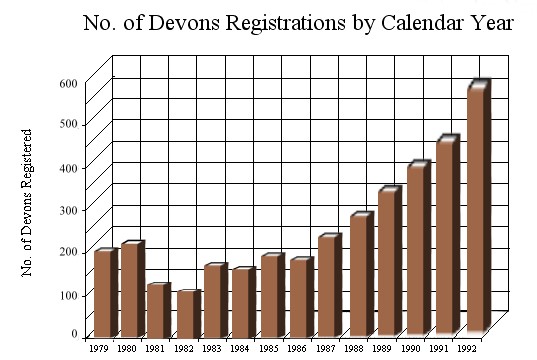
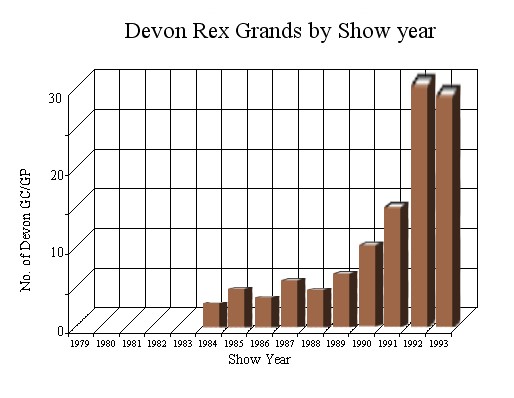
no doubt that the Devon situation in CFA has
changed since those bleak early days. Though relatively flat (or even declining
for a short period) until about five years ago, registrations and show success
have lately increased rapidly, paralleling the growth, mentioned above, of
numbers of show entries and Devon fanciers. The graphs are presented below. The
1992 registration total, 557 cats, is an increase of 37% from 1991 and places
the breed as the 16th most popular. The numbers tell the story, bespeaking a
breed on the move. Look for a growing presence of Devons on the scene, as this
delightful breed bewitches more and more people.
References:
Giger, Urs, et al., "Geographical Variation of the
Feline Blood Type Frequencies in the United States." Feline
Practice 19: 21-27, Nov/Dec 1991.
Gibney, A, "Why There Are Two: The Story of the Cornish
Rex and the Devon Rex," CFA Yearbook,
1986, p.624-631, and extensive references cited therein.
|